Body bending produces the sharpest turns
In the slow regime, the model assigns the strongest curvature control to body bending. This is the most effective way to generate tight turning without relying on larger lateral displacements.
Interactive supplement and reproducibility hub for the published article Speed-Dependent Turning Strategies in Quadrupedal Locomotion: Insights from Computational Modeling. This page is designed to help readers move between the paper, the interactive animator, and the underlying simulation code without feeling like they are leaving the publication context.
Research group: Yaroslav Molkov's group at Georgia State University
Figure 7 compares maximal achievable curvature across the three turning strategies and makes the speed dependence of the paper’s main result immediately visible.
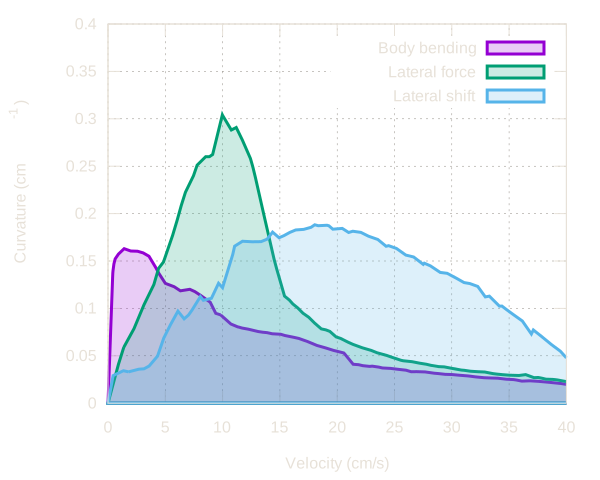
In the slow regime, the model assigns the strongest curvature control to body bending. This is the most effective way to generate tight turning without relying on larger lateral displacements.
Across intermediate speeds, the most effective turns come from lateral force application. This is the regime where sideways propulsion produces the clearest improvement in turning performance.
As speed increases, shifting the body laterally becomes the most effective steering strategy. The model suggests that the turning solution changes with the demands of faster locomotion.
Across these regimes, the forelimbs play a primary steering role and the hindlimbs re-balance propulsion and stability. The limb timing changes are part of the result, not just a side effect.
The paper extends an earlier quadrupedal locomotion model to compare three asymmetric turning mechanisms: body bending, lateral force application, and lateral shifting. Rather than treating turning as a small correction to symmetric forward walking, the model asks how asymmetric mechanics and locomotor speed combine to produce different turning outcomes.
This companion page keeps the publication framing intact while exposing the interactive and reproducible pieces that are difficult to show directly inside a paper: browser-based exploration, downloadable source, and the concrete commands used to regenerate animations and sweeps.
Explore steering controls in the browser and inspect the turning behaviors without building video files first. This is the main interactive entry point for the companion site.
Launch animatorRead the final journal article on Frontiers or jump directly to the PDF when you want the publication itself rather than the interactive supplement.
Open articleDownload the source archive containing the C++ model, animation and sweep plot files, and local build targets used to regenerate the example media and parameter sweeps.
Download source
Local reproduction requires g++, make, gnuplot, ffmpeg, and bc.
The commands below use the bundled source archive to build the simulator, principal example animations, and parameter sweeps.
sudo apt update sudo apt install build-essential gnuplot ffmpeg bc unzip turning.zip -d turning-source cd turning-source make
make examples make results/lateral_force.mp4 make results/body_bending.mp4 make results/lateral_shift.mp4 make delta make force make shift